
Grammar Lessons
Structured lessons from beginner to advanced — built around real research, real language, and real learners.
Field of Dreams
Pre-K
The Golden Thread of Words: How Bilingual Children Build Vocabulary
Hearing language is essential for every child, whether they grow up with one language or several. For multilingual children, though, the input they receive is more varied. It matters which language a child is spoken to in, whether the speech mixes words from both languages (code-switching), whether the speakers are multilingual themselves, and whether a language makes up most of what the child hears or only a small share. Each of these shapes the linguistic world a child learns words in, like different veins running through a seam of ore.
Children also differ in how quickly they process words. Speech moves at roughly two and a half words per second, so a child who spots a word fast and accurately has mental energy left over to notice the surrounding context. That builds richer, sturdier word knowledge. Efficient processors also need fewer encounters with a word's sound pattern to recognize it, which speeds up vocabulary growth.
Speed and input are linked, too. Research with bilingual children shows that processing speed depends on exposure and is specific to each language. Between ages two and three, a child's relative efficiency in their two languages tracks their relative vocabulary in those languages. A two-year-old who hears more Spanish than English, for instance, will retrieve Spanish words faster and learn more of them. A child's word-learning skill, then, isn't only a personal trait — it is closely tied to what they hear.
Children become bilingual in many ways, using their languages in different settings, at different times, and with different people. Their vocabulary is spread across both languages and overlaps only in part. Some words are known in just one language and are called singlets. A child might know math terms only in the language of school, or know the names of certain foods or religious customs only in the home language. This is perfectly natural, and adult bilinguals experience it too.
Other words, called doublets or translation equivalents, are known in both languages because the child meets those ideas regularly in each.
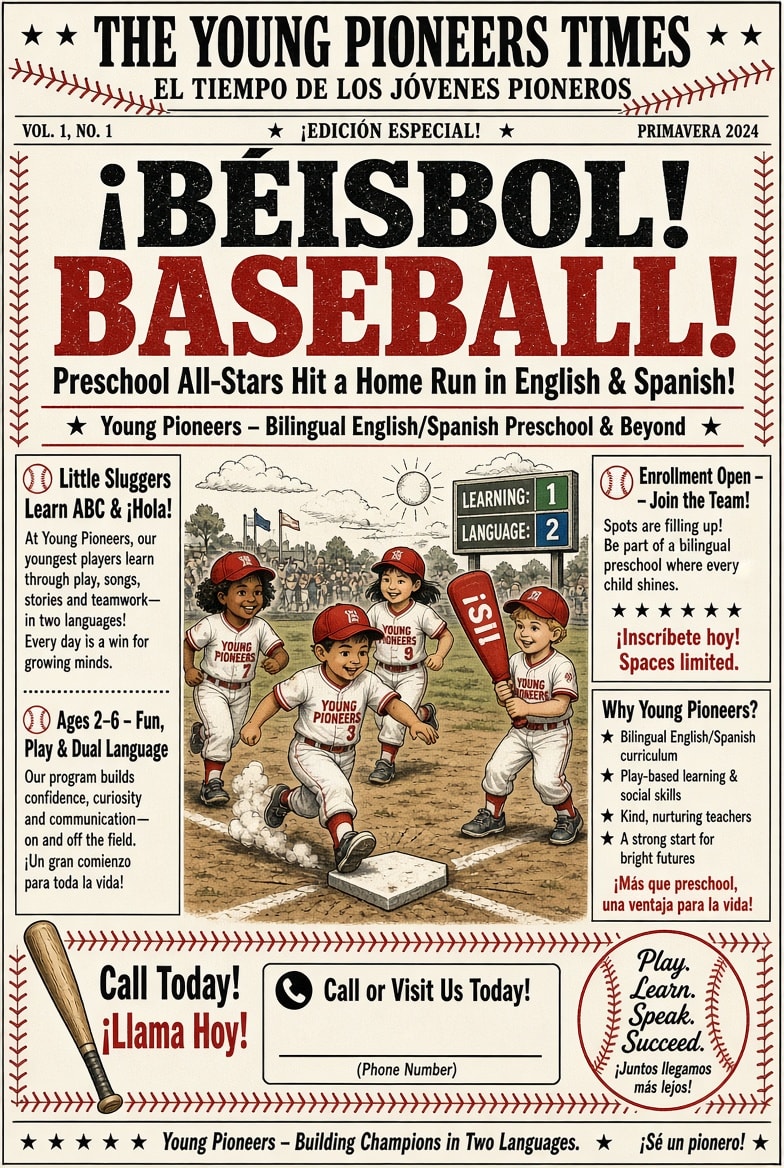
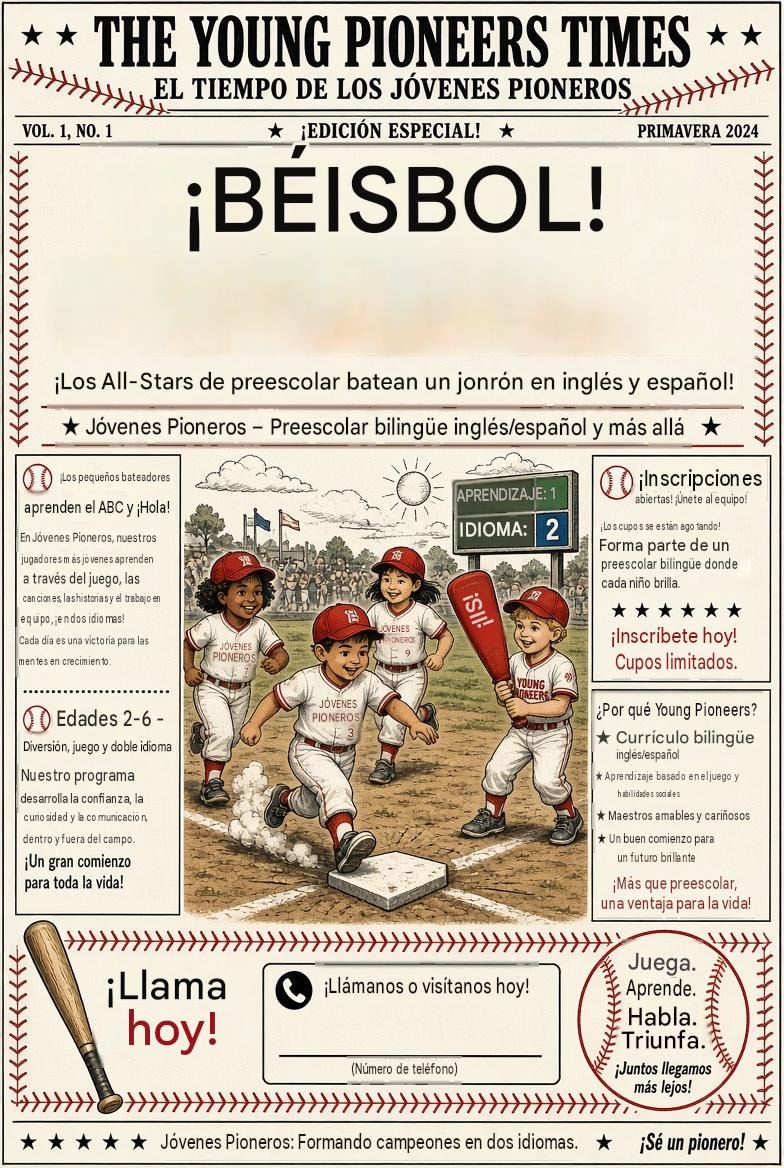
Why Young Pioneers?
More than preschool — a life advantage. Más que preescolar, una ventaja para la vida.
Bilingual English/Spanish Curriculum
Every lesson, song, and story is delivered in both languages. Children build dual-language fluency naturally through play and daily routines.
Play-Based Learning & Social Skills
Learning through games, dramatic play, and cooperative activities builds confidence, curiosity, and communication — on and off the field.
Early Literacy & ABC · ¡Hola!
Little sluggers learn letter recognition, phonics, and pre-reading skills alongside Spanish vocabulary — a strong start for growing minds.
Number Sense · Ages 2–6
Counting, patterns, and hands-on math play in English and Spanish. Every day is a win for developing mathematical thinking.
Kind, Nurturing Teachers
Our educators are warm, bilingual, and deeply committed to every child's growth. Small class sizes mean every learner is seen and celebrated.
A Strong Start for Bright Futures
Play. Learn. Speak. Succeed. Juega. Aprende. Habla. Triunfa. Juntos llegamos más lejos — together we go further.
Young Pioneers Program Overview
Download the full program overview — curriculum, goals, and what makes Young Pioneers special.
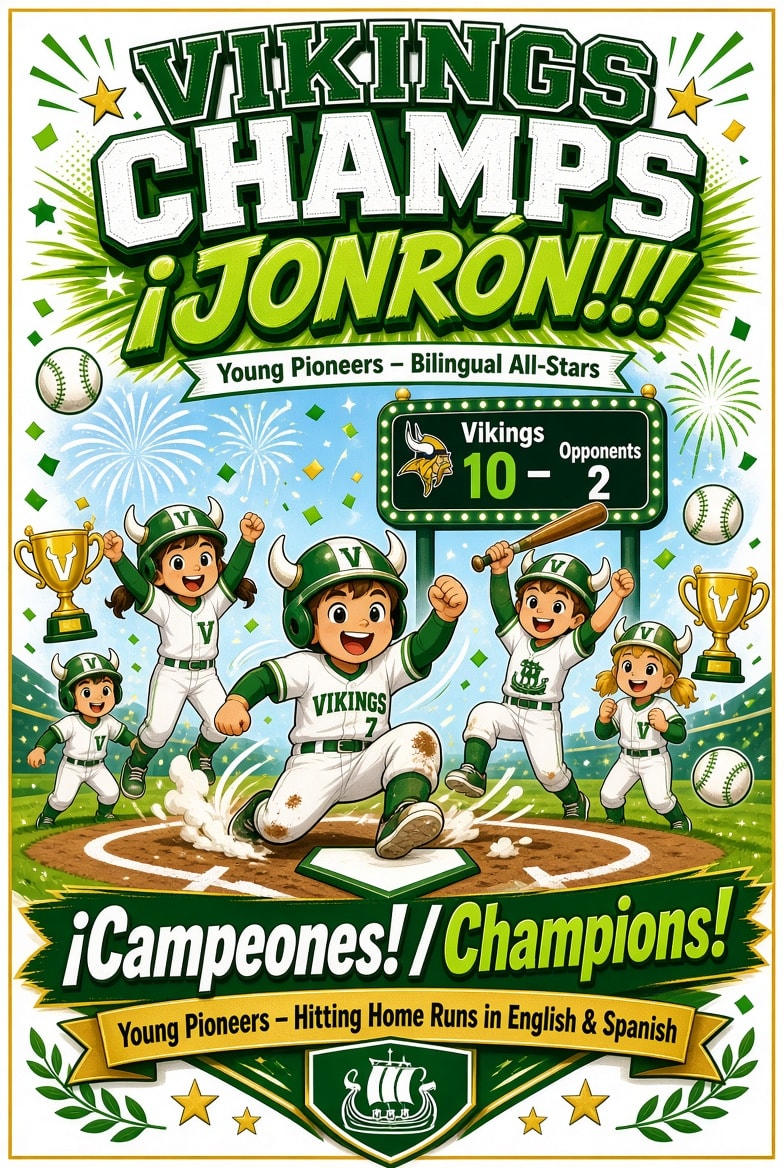
¡Campeones! / Champions!
Hitting home runs in English & Spanish. Our Vikings team shows what bilingual learners can achieve when they play together, learn together, and celebrate together.
"Young Pioneers — Building Champions in Two Languages. ¡Sé un pionero!"
Theme-Based Weekly Units
Each week centers on a rich bilingual theme — weaving literacy, math, science, and social studies into every activity.
A Day in the Life · Un Día en la Vida
Morning Arrival & Free Play
Llegada y juego libre
Circle Time — Songs & Calendar
Tiempo en círculo — canciones y calendario
Literacy Block — Letters & Phonics
Bloque de lectura — letras y fonética
Snack & Social Time
Merienda y tiempo social
Math & Science Exploration
Exploración de matemáticas y ciencias
Spanish Immersion Activity
Actividad de inmersión en español
Lunch & Rest
Almuerzo y descanso
Creative Arts & Music
Artes creativas y música
Outdoor Play & Movement
Juego al aire libre y movimiento
Story Time & Closing Circle
Hora del cuento y círculo de cierre
Spaces are filling up · ¡Los cupos se están llenando!
Join the Team · Únete al Equipo
Be part of a bilingual preschool where every child shines. ¡Un gran comienzo para toda la vida!
Teacher's Note
Mumbo Jumbo is one of the best bilingual warm-up games you will ever run in a Pre-K classroom. It is loud on purpose. It is silly on purpose. And that is exactly the point — when little learners are laughing and moving, their brains are wide open. Every shout of "¡PERRO!" is a word that sticks. Every jump on "¡SALTA!" is a memory that lasts. No flashcards required. No pressure. Just pure, joyful language acquisition doing its thing.
Play it at circle time, use it as a transition, or pull it out when the room needs energy. It works every single time.
Mumbo Jumbo
The silly bilingual mix-up game for ages 3–6. Loud, active, picture-friendly — and built for switching between English and Spanish without pressure.
🎒 What You Need
- → Space to move and your voice
- → Optional: simple picture cards or toys (animals, colors, foods, body parts)
- → Optional: a scarf or soft toy as the "Mumbo Jumbo wand"
- → 2–6 players (or a whole group with an adult leading)
🧠 Why It Works
- ✓ Short turns and big movements keep attention
- ✓ No reading required
- ✓ Switching directions (English→Spanish and back) builds flexible thinking
- ✓ Silliness removes fear of mistakes — wrong answers just become funnier actions
- ✓ Builds core vocab: animals, colors, numbers 1–5, body parts, foods, verbs, feelings
⚾ How to Play — Basic Version (5–10 min rounds)
- 1
Gather in a circle or open space. Adult or older child starts as the Mumbo Jumbo Leader.
- 2
Leader waves the wand (or just arms) and shouts: "Mumbo Jumbo… DOG!" Everyone answers together with the Spanish word + a silly action: "¡PERRO!" (bark + crawl or wag "tail").
- 3
Leader immediately switches: "Mumbo Jumbo… ¡GATO!" Kids reply: "CAT!" (meow + stretch like a cat). Keep the pace fast and playful.
- 4
Mix in body parts, colors, foods, and verbs — "Mumbo Jumbo… RED!" → "¡ROJO!" (wave arms like big red flags) · "Mumbo Jumbo… JUMP!" → "¡SALTA!" (everyone jumps)
- 5
Every few turns the Leader calls "MUMBO JUMBO FREEZE!" — everyone freezes in a silly pose. First one to move does a quick extra action (spin, roar, etc.) then play continues. No one is "out" — just more silliness.
- 6
Pass the wand so different kids get to be Leader. Praise every attempt loudly — "¡Sí!" / "Yes!" / "Great try!"
Picture Version (ages 3–4)
Hold up a picture or toy. Kids shout the word in the other language + do the action. Great for younger learners.
Mix-Up Mode (ages 5–6)
Leader says a tiny mixed phrase ("The perro is big!"). Kids fix it by saying the clean version in one language while acting it out.
Action Chain
Leader says a word, first child translates + acts, next child adds another related word in the other language, and so on around the circle.
Song Twist
Chant to a simple rhythm — "Mumbo Jumbo, dog-perro, cat-gato, jump-salta… Mumbo Jumbo!" Clap or march between words.
Ready to start right now?
Point to something in the room or hold up your hand and shout:
"Mumbo Jumbo… HAND!"
Kids should yell "¡MANO!" and wave wildly. Your turn — invent the next word and keep the jumble going!
Teacher's Note
WordSpy is the quiet power move of the bilingual classroom. No materials. No setup. No noise level to manage. Just a teacher's voice, a room full of curious eyes, and a word that suddenly means something because a child found it. That moment of discovery — "I see it!" — is the whole lesson. Observation, vocabulary, and confidence in one breath.
Run it as a five-minute filler, a morning warm-up, or a cool-down after Mumbo Jumbo. It pairs perfectly with any theme week and works in English, Spanish, or both at once.
WordSpy
A bilingual I-Spy observation game for ages 2–6. No materials needed — just your voice, the room, and a word. Works in English, Spanish, or both at once.
🎯 How to Play
- → Teacher calls out a word: "I spy something red!"
- → Kids point, touch, or shout what they find in the room
- → Switch to Spanish: "¡Veo algo rojo!" — same game, new language
- → Mix it up: colors, shapes, objects, body parts, actions
- → Call-and-response mode: Teacher says "Hello!" — Kids answer "¡Hola!"
- → No wrong answers — every response is a win
🧠 Why It Works
- ✦ Builds vocabulary through real-world observation, not memorization
- ✦ Zero prep — the classroom is the game board
- ✦ Bilingual switching feels natural, not forced
- ✦ Develops listening, attention, and category thinking
- ✦ Every child participates — no waiting for a turn
- ✦ Pairs perfectly after Mumbo Jumbo as a calm-down activity
Game Modes
I Spy It
I spy something blue.
Veo algo azul.
Kids point or shout what they find
Touch It
Touch something round.
Toca algo redondo.
Kids move and touch the object
Hello Friend
Hello! / Friend! / Water!
¡Hola! / ¡Amigo! / ¡Agua!
Call-and-response, fast pace
Safe or Not?
Helping ✅ Pushing ❌
Ayudar ✅ Empujar ❌
Kids show thumbs up or down
Core Word Set · Ages 2–5
Hello
Hola
Friend
Amigo
Book
Libro
Water
Agua
Dog
Perro
Bird
Pájaro
Sun
Sol
Help
Ayuda
Safe
Seguro
Family
Familia
10 words · enough to power dozens of circle-time games, picture cards, and bilingual activities
The Sectional Game
The game that became a story. The story that became a lesson. El juego que se convirtió en historia.
Game Story · Historia del Juego
High School Sectional Final
Vikings vs. Wolves · Top of the 9th · Tied 3–3
It's the high school sectional final. The Vikings and the Wolves are tied 3–3 going into the top of the 9th. The Vikings have the bases loaded. Two outs. Full count. The stadium is silent.
Parents, students, and the whole town are standing. The Wolves' pitcher stares in. The Vikings' best batter steps up — this is the moment the whole season has been building toward.
He swings…
CRACK!
The ball flies high… higher… toward the left-field fence…
The crowd holds its breath…
It's going… going…
¡JONRÓN!
Grand slam. Vikings lead 7–3. They hold on to win the sectional! 🏆
🎓 From the Field to the Classroom
How would you feel if you hit that grand slam jonrón for your school?
How would you feel if you were the pitcher who gave it up?
Have you ever experienced a moment this intense in sports or life?
Which team would you root for — Vikings or Wolves — and why?
🎙️ Live Commentary Challenge
Groups of 3: one student is the radio commentator, two are the crowd and players. Perform the final at-bat live — build the tension, call the pitch, explode when the ball goes out:
"It's high… it's deep… it is… GONE! Vikings win the sectional on a grand slam jonrón!"
Chicholo's Letter to Mom
On the matter of retired colors, institutional memory, and the Great Crayon Box Beyond.
Noble Pioneers Pre-K
123 Academy Drive · Valparaiso, IN · (123) 456-7890
September 22, 2026
Noble Pioneers Mom
123 Sturdy AF Road · Valparaiso, IN
Dear Mom,
There are, in fact, retired colors hidden away at school.
They are carefully stored between old bulletin boards, forgotten laminating projects, and boxes labeled "Important Classroom Stuff."
Some colors served nobly.
🟤 "1978 Auditorium Brown"
🟨 "Mystery Yellow #4"
🟩 "Institutional Mint"
🟪 "Purple That Nobody Could Match"
Their watch has ended.
The current regime favors:
🩸 Oxblood
⭐ Antique Gold
🤍 Cream
🌙 Deep Navy
The retired colors are not in danger. They receive respectful archival treatment and occasional visits from historians, custodians, and curious Pre-K Pioneers.
Should any child ask:
"What happened to the old colors?"
The answer is:
"They blazed the trail before us and now rest in the Great Crayon Box Beyond."
Respectfully,
Chicholo
Headmaster Emeritus of Color Preservation
Casa de Chicholo · Home of Lottsadottis 🐭⭐📚
P.S. The golden star path was absolutely necessary. Every committee agreed. 😄
Best regards,
Chicholo
CEO, Noble Pioneers Pre-K
Chicholo's Mass Mailing
A note to every bilingual family in the building
Raising a bilingual or multilingual kid? That's something to be proud of. Your child can tell a great story in every language they speak, whether it's a library book at school or a tale told around Grandma's kitchen table.
Not much reading in the family language at home? Don't sweat it. Bedtime stories, road-trip tall tales, and "you won't believe what happened at recess" all count. Here's the good news: a good story works the same way in just about any language — with a beginning, a problem, and a happy (or at least satisfying) ending. It's as American as apple pie, and just as universal, so research shows multilingual kids usually get that big-picture arc down pat no matter which language they're speaking.
The finer points just take a little practice and plenty of time in the saddle. We're talking about time words like "before" and "after," the right verb tenses ("went," not "go"), words for thoughts and feelings like "thinking" or "expecting," and cause-and-effect sentences such as "The fox ran away because he was scared."
If your kid is stronger in one language than the other, that's perfectly normal — don't worry. Culture matters too. Some families like a story told in straight, chronological order, while others pile on the feelings and the flair, so your child might tell a tale a little differently in each language. That's part of what makes their voice their own.
And the real MVP? Vocabulary. A big, solid word bank helps kids read between the lines and pick up on what a story only hints at. What counts is both breadth — how many words they know — and depth — how well they know each one and how it connects to others. The more your child hears and uses each language, the better they'll understand the stories they hear.
So pitch in at home. Swap stories in every language your child speaks, ask them to walk you through their day from start to finish, and throw in questions like "Why do you think she did that?" Use a good mix of words, explain the new ones, and hand down those family stories — the kind that get better every time they're told.
Every language your child speaks is one more way to tell a great story.
With love and loud hallways,
Chicholo
CEO, Noble Pioneers Pre-K · Casa de Chicholo 🐭⭐📚
Field of Dreams Mini-Game
¡Jonrón Derby! 🏟️
Step up to the plate — can you hit a home run?
Tap the bat or the button to swing. Home run odds: 1 in 9 — ¡buena suerte!
⚾ How the odds work
Making contact: 5 out of 9 swings (~55.6%). Of those contact swings, 1 in 5 leaves the yard — so your overall home run chance is exactly 1 in 9 (~11.1%). Just like the real game!